
Rechargeable vs Pedestal Fan: Which One Should You Buy?
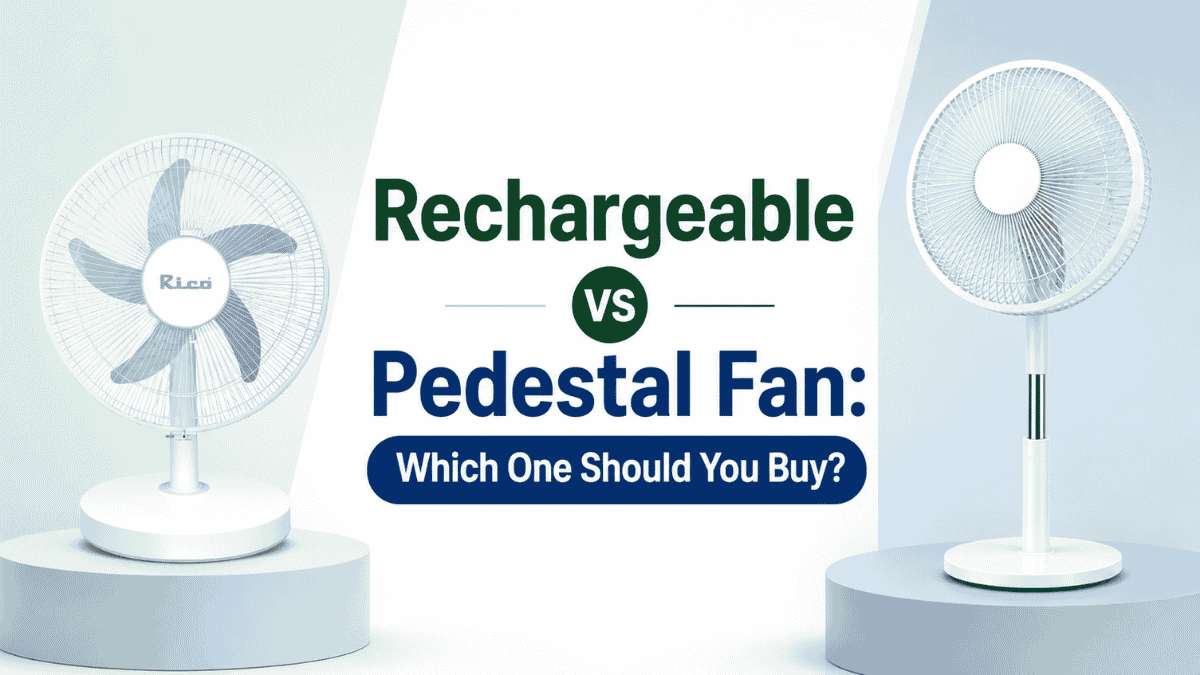
Choosing between a rechargeable vs pedestal fan often comes down to one simple question: do you need portability or raw cooling power? Both fans serve different purposes, and understanding this difference can save you from a purchase you'll regret.
A rechargeable fan runs on a built-in battery and works even during power cuts. A pedestal fan, on the other hand, plugs directly into the mains and delivers strong, continuous airflow for larger spaces.
If you're looking for reliable cooling solutions, Rico offers a wide range of home appliances, including rechargeable fans, pedestal fans, air coolers, steam irons, mixer grinders, and other everyday essentials. Rico products are designed to deliver dependable performance, energy efficiency, and long-lasting durability for modern Indian households.
This guide breaks down the rechargeable vs pedestal fan debate across power, performance, portability, and price, helping you choose the fan that best suits your home, lifestyle, and cooling needs.
What Is a Rechargeable Fan?
A rechargeable fan comes with a built-in battery that charges via a USB cable. Once charged, it can run independently of a live power connection, which makes it especially useful during outages.
Most rechargeable fans are compact and lightweight, designed for personal cooling rather than whole-room airflow. They typically offer multiple speed settings, and some models even include LED lighting for added utility during power cuts.
What Is a Pedestal Fan?
A pedestal fan is a mains-powered standing fan mounted on an adjustable pole. It delivers strong, wide-reaching airflow, making it suitable for bedrooms, living rooms, and even larger halls.
Pedestal fans typically feature higher-wattage motors, oscillation for wider coverage, and adjustable height settings. Since they depend on a direct power connection, they don't function during outages unless paired with an inverter or backup power source.
Rechargeable vs Pedestal Fan: Key Differences  Let's compare both fan types across the factors that matter most for everyday use.
1. Power Source and Backup
This is the most fundamental difference in the rechargeable vs pedestal fan comparison. Rechargeable fans store power in an internal battery, so they keep running through power cuts. Pedestal fans require a constant electricity supply and stop working the moment the power goes out.
If frequent outages are a concern in your area, it's worth understanding how other home appliances handle backup power too. Our guide on using a mixer grinder on an inverter explains similar load considerations that apply when running appliances on limited backup power.
2. Airflow and Cooling Power
Pedestal fans clearly win on raw cooling performance. Depending on the model, they deliver airflow ranging from roughly 60 to over 100 CMM (cubic metres per minute), with motors typically rated between 50W and 160W.
Rechargeable fans, by comparison, are built for focused, personal cooling rather than whole-room airflow. Their smaller blades and battery-driven motors simply can't match a pedestal fan's air delivery across a larger space.
3. Wattage and Power Consumption
Pedestal fans generally consume more power due to their stronger motors, though many models still run efficiently at 50 to 70 watts on average. Rechargeable fans consume very little power while charging and draw no electricity at all once running on battery.
Wattage differences like this affect performance across many home appliances, not just fans. Our breakdown of the difference between 550W and 750W mixer grinders explains a similar principle: higher wattage generally means stronger output, but efficiency still depends on design.
4. Portability
Rechargeable fans are significantly more portable. Their compact, lightweight design makes them easy to carry between rooms, desks, or even outdoors during travel.
Pedestal fans, while movable, are bulkier and less convenient to relocate frequently. Their weight and base design prioritise stability over portability, which is the trade-off you accept for stronger airflow.
This kind of weight-versus-performance trade-off shows up in other appliances too. Our comparison of heavyweight vs lightweight iron boxes explores a similar decision between convenience and performance.
5. Noise Levels
Pedestal fans, especially at higher speeds, tend to generate more noise due to their stronger motors and larger blade sweep. Rechargeable fans generally run quieter, particularly at lower speed settings.
If noise is a priority in your household, our guide on how to reduce the noise of a mixer grinder shares maintenance tips that apply broadly to motor-driven appliances, including fans.
6. Battery Life and Runtime
A typical rechargeable fan offers a battery backup of anywhere between 2 and 10 hours, depending on the speed setting and battery capacity. Lower speeds naturally extend runtime, while higher speeds drain the battery faster.
Pedestal fans, since they run on mains power, don't face this limitation. As long as electricity is available, they can run continuously without needing to recharge.
7. Price and Value
Rechargeable fans are generally priced based on battery capacity and features, often ranging from budget-friendly to mid-range depending on the brand. Pedestal fans, priced roughly between ₹2,000 and ₹6,000, cost more upfront but deliver stronger, whole-room cooling in return.
Rechargeable vs Pedestal Fan: Quick Comparison
|
Feature |
Rechargeable Fan |
Pedestal Fan |
|
Power source |
Battery, USB rechargeable |
Direct mains connection |
|
Works during power cuts |
Yes |
No, unless on inverter |
|
Airflow strength |
Moderate, personal cooling |
High, whole-room cooling |
|
Portability |
Very portable, lightweight |
Movable, but bulkier |
|
Typical wattage |
Low, battery-based |
50W to 160W |
|
Best for |
Desks, travel, small spaces |
Bedrooms, halls, larger rooms |
Which One Should You Choose?
Your decision in the rechargeable vs pedestal fan debate ultimately depends on your specific needs. Here's a simple way to decide.
Choose a rechargeable fan if:
-
You experience frequent power cuts and need reliable backup cooling
-
You want a portable option for your desk, bedside, or travel
-
Your space is small and doesn't need strong whole-room airflow
-
You prefer quieter operation for personal use
Choose a pedestal fan if:
-
You need to cool a larger room, hall, or living space
-
You have consistent power supply and don't need battery backup
-
You want oscillation and adjustable height for wider coverage
-
Long-term running cost and airflow strength matter more than portability
Can You Use Both Together?
Many households don't have to choose just one. A pedestal fan can handle daily cooling for larger rooms, while a rechargeable fan serves as a reliable backup during outages or for personal use at a desk.
This combination approach mirrors how people often build out their broader appliance collection at home, mixing specialised tools rather than relying on a single device. If you're planning your home appliances more broadly, our roundup of kitchen products covers other everyday essentials worth considering alongside your cooling setup.
Tips for Getting the Most from Either Fan
Whichever option you choose, a few habits can improve performance and lifespan.
-
Clean the blades and grills regularly to maintain smooth airflow.
-
Use lower speed settings when full power isn't necessary, since this reduces both noise and energy use.
-
For rechargeable fans, avoid letting the battery fully drain repeatedly, as this can shorten its lifespan over time.
-
For pedestal fans, check the oscillation mechanism periodically to ensure even air coverage.
-
Position pedestal fans away from walls or furniture to allow proper air circulation.
Final Verdict
The rechargeable vs pedestal fan decision comes down to how and where you need cooling. Rechargeable fans win on portability and power-cut reliability, while pedestal fans win decisively on raw airflow and whole-room performance.
If your priority is dependable backup cooling during outages, a rechargeable fan makes more sense. However, if you need strong, consistent airflow for a larger space, a pedestal fan remains the better long-term investment.
Ultimately, understanding your household's specific needs, whether that's portability, power backup, or cooling strength, will make the rechargeable vs pedestal fan choice much easier.
Frequently Asked Questions
Q1. Which is better: a rechargeable fan or a pedestal fan?
It depends on your needs. A rechargeable fan is better for portability and power-cut backup, while a pedestal fan offers stronger airflow for larger rooms.
Q2. How long does a rechargeable fan last on a single charge?
Most rechargeable fans run between 2 and 10 hours on a full charge, depending on the speed setting used.
Q3. Does a pedestal fan consume more electricity than a rechargeable fan?
Yes, generally. Pedestal fans typically consume 50 to 160 watts of power, while rechargeable fans use minimal electricity, mainly during charging.
Q4. Can a pedestal fan work during a power cut?
No, not unless it's connected to an inverter or backup power source, since it relies entirely on mains electricity.
Q5. Is a rechargeable fan strong enough to cool an entire room?
Not typically. Rechargeable fans are better suited for personal or focused cooling rather than circulating air across an entire room.