
Centrifugal Juicer vs Slow Juicer: Key Differences Explained
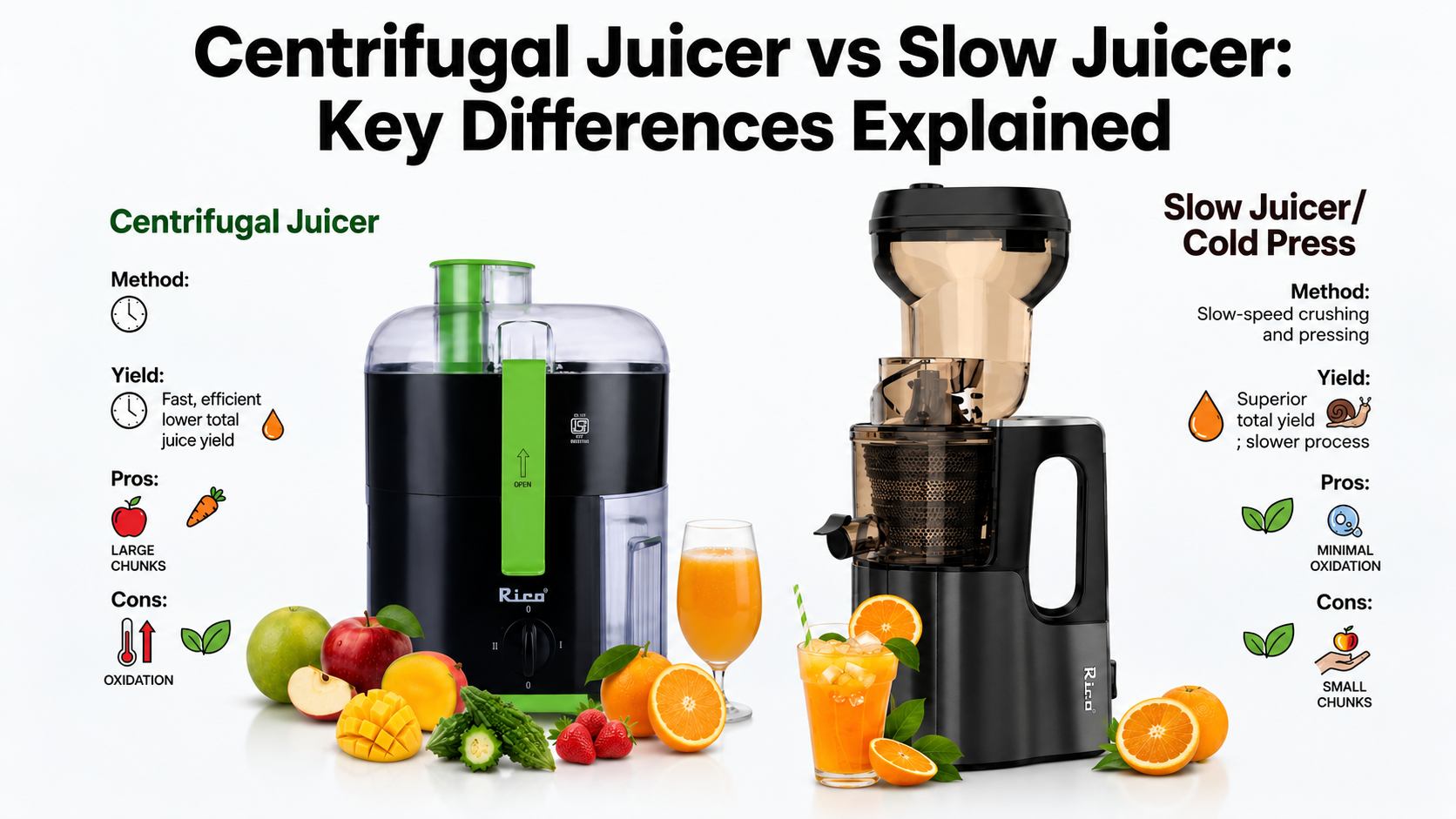
You want fresh juice every morning. You have looked at a dozen options online and narrowed your choice to two categories: centrifugal juicers and slow juicers. Both extract juice and fit neatly on your kitchen counter, but the way they work, the quality of juice they produce, and the users they are best suited for are entirely different.
If you're wondering what a centrifugal juicer is, how it differs from a slow juicer, and which one is the better choice for your household, this guide explains everything in simple, practical terms. Whether you choose a centrifugal or a slow juicer, investing in a reliable appliance makes all the difference. At Rico.in, you'll find high-quality slow juicers and a wide range of kitchen appliances designed to make healthy living easier every day.
What Is a Centrifugal Juicer?
A centrifugal juicer is the most common type of electric juicer. It works by using a fast-spinning flat cutting blade - typically rotating at 6,000 to 14,000 RPM - to shred fruits and vegetables into tiny pieces. The centrifugal force generated by this high-speed spinning then pushes the juice outward through a mesh filter, separating it from the pulp.
The entire process happens in seconds. You push a fruit or vegetable through the feed chute, the spinning blade shreds it instantly, and juice flows out of one spout while dry pulp collects in a separate container.
In simple terms: a centrifugal juicer works the same way a spin dryer works - it spins at very high speed to force juice out of the pulp through centrifugal force.
How a Centrifugal Juicer Works - Step by Step
-
Fruit or vegetable is pushed down the feed chute
-
A high-speed spinning blade (6,000–14,000 RPM) shreds the produce
-
Centrifugal force pushes the liquid outward through a mesh filter
-
Juice collects in a jug below; pulp collects in a separate container
-
Entire process takes 10–30 seconds per batch
This is why centrifugal juicers are popular - they are fast, straightforward, and easy to operate for everyday use.
What Is a Slow Juicer?
A slow juicer - also called a cold press juicer or masticating juicer - works on a completely different principle. Instead of spinning at high speed, it uses a slowly rotating auger (a screw-like gear) to squeeze and press fruits and vegetables against a mesh filter. The pressing action extracts juice at a low RPM, typically between 40–80 RPM.
Because no high-speed blade is involved, there is no heat friction and significantly less oxidation. The juice retains more vitamins, enzymes, and natural colour - and stays fresh longer after extraction.
In simple terms: a slow juicer works like a hand press - it squeezes produce slowly and thoroughly, the way you would squeeze an orange by hand, but mechanised.
Centrifugal Juicer vs Slow Juicer: Side-by-Side Comparison
|
Feature |
Centrifugal Juicer |
Slow Juicer (Cold Press) |
|
Operating Speed |
6,000–14,000 RPM |
40–80 RPM |
|
Extraction Method |
High-speed spinning blade |
Slow press/auger squeeze |
|
Juicing Speed |
Very fast - 10–30 seconds |
Slower - 1–3 minutes |
|
Noise Level |
High - 70–90 dB |
Low - under 60 dB |
|
Heat Generated |
Some friction heat |
Minimal - near zero |
|
Oxidation |
Higher |
Minimal |
|
Nutrient Retention |
Moderate |
Maximum |
|
Juice Shelf Life |
15–20 minutes (best fresh) |
Up to 48–72 hours refrigerated |
|
Juice Yield |
Moderate - some pulp in juice |
Maximum - driest pulp |
|
Leafy Greens |
Struggles (spinach, wheatgrass) |
Handles well |
|
Hard Produce |
Excellent (carrots, beetroot) |
Excellent |
|
Soft Fruits |
Good |
Excellent |
|
Noise |
Loud |
Quiet |
|
Price Range |
₹2,500–₹8,000 |
₹6,000–₹30,000+ |
|
Cleaning Time |
5–10 minutes |
10–15 minutes |
|
Counter Space |
Compact |
Slightly larger |
Key Differences Explained - What Actually Matters
Nutrient Retention
This is the most important difference between a centrifugal juicer and a slow juicer for health-conscious buyers.
When a centrifugal juicer spins at 14,000 RPM, friction creates mild heat. This heat, combined with the air exposure during spinning, causes oxidation - a chemical reaction that breaks down certain vitamins, particularly Vitamin C and heat-sensitive enzymes. The juice is still nutritious, but some of that nutrition is lost in the process.
A slow juicer's pressing action generates almost no heat and minimal air exposure. Oxidation is significantly reduced, which means more vitamins, enzymes, and antioxidants reach your glass intact.
Practical example: A glass of carrot juice from a centrifugal juicer may contain 70–80% of the carrot's original Vitamin C. The same carrot juiced in a slow juicer at 46 RPM retains significantly more - and the colour will be noticeably brighter and deeper.
Juice Yield
A slow juicer extracts more juice from the same quantity of produce because the pressing action is more thorough. The pulp that comes out of a slow juicer is noticeably drier than pulp from a centrifugal juicer. Over a week of daily juicing, this difference adds up - you buy less produce and get more juice from what you have.
Noise
A centrifugal juicer is loud - comparable to a blender or mixer grinder at full speed. A slow juicer operates at under 60 dB - quiet enough to use in the kitchen while someone is sleeping in the next room. For early morning juicing in Indian households, this difference is practically significant.
What Each Juices Best
|
Produce Type |
Centrifugal Juicer |
Slow Juicer |
|
Apples, pears, watermelon |
Excellent |
Excellent |
|
Carrots, beetroot |
Excellent |
Excellent |
|
Oranges, mosambi |
Good |
Excellent |
|
Leafy greens (spinach, mint, curry leaves) |
Poor |
Excellent |
|
Wheatgrass |
Very Poor |
Excellent |
|
Ginger, turmeric |
Average |
Excellent |
|
Pomegranate |
Average |
Good |
|
Coconut |
No |
Yes (select models) |
For Indian households that juice carrots, beetroot, apples, and mosambi daily - both types work. But if wheatgrass, leafy greens, ginger shots, or coconut milk extraction are part of your routine, a slow juicer is the only suitable option.
When a Centrifugal Juicer Makes Sense
A centrifugal juicer is the right choice when:
-
You want fresh juice quickly in the morning with minimal wait time
-
Your primary produce is hard fruits and vegetables - apples, carrots, beetroot, cucumbers
-
You prefer a lower upfront investment
-
You will drink juice immediately after extraction - not storing it
-
Counter space is limited and compact footprint matters
-
You are new to juicing and want to try it without a large commitment
The Rico Centrifugal Juicer JE1401 is a 350W centrifugal juicer with double ball bearings for continuous extraction, a drip-stop spout, anti-slip vacuum feet, and a compact design built for daily Indian household use. Priced at ₹3,500 with a 2-year replacement warranty, it is the practical choice for households that want reliable, everyday centrifugal juicing.
When a Slow Juicer Makes Sense
A slow juicer is the right choice when:
-
You juice every morning as a serious health or nutrition practice
-
You want maximum nutrient retention in every glass
-
Your produce includes leafy greens, wheatgrass, ginger, and turmeric
-
You want to juice in the early morning without noise
-
You want juice that stays fresh in the fridge for 24–72 hours
-
You want to extract nut milk, coconut milk, or make frozen fruit ice cream
The Rico Slow Juicer SJ2508 operates at just 46 RPM on a 300W DC motor - the lowest RPM in its class. It includes a 75 mm wide-mouth feed chute for whole fruits, an ice cream maker attachment, nut milk and coconut milk capability, an anti-drip smart cap, and comes with a 5-year warranty backed by 350+ service centres across India. For serious daily juicing, it is the strongest option in the market.
Can You Use Both? The Two-Juicer Kitchen
Many health-focused Indian households eventually own both. A centrifugal juicer handles the quick morning apple-carrot-cucumber juice; a slow juicer handles the weekend wheatgrass shots, green detox blends, and nut milk batches. The two complement each other rather than compete.
Rico's complete juicer range covers both categories - so you can start with one and expand to the other as your juicing routine evolves.
How Does a Juicer Differ from a Mixer Grinder or Food Processor?
A common question in Indian kitchens is whether a juicer, a mixer grinder, or a food processor can replace each other.
|
Appliance |
Primary Function |
Can It Juice? |
|
Centrifugal Juicer |
High-speed juice extraction |
Yes - its primary purpose |
|
Slow Juicer |
Cold press juice extraction |
Yes - its primary purpose |
|
Mixer Grinder |
Grinding, blending, batters |
No - it blends with water, does not separate juice from pulp |
|
Food Processor |
Slicing, chopping, kneading |
No |
|
Hand Blender with Chopper |
Blending, chopping |
No - blends with liquid present, does not separate |
A juicer is not replaceable by a mixer grinder or blender in an Indian kitchen. They perform fundamentally different functions and work best as a complete set.
Conclusion
Understanding what a centrifugal juicer is and how it compares to a slow juicer comes down to one question: how seriously do you juice, and what do you juice?
For quick, everyday extraction of common fruits and vegetables - the Rico Centrifugal Juicer JE1401 at ₹3,500 is the practical, reliable choice. For serious daily nutrition - leafy greens, nut milk, maximum nutrient retention, and juice that stays fresh through the day - the Rico Slow Juicer SJ2508 at 46 RPM with a 5-year warranty is the definitive investment.
Rico India has been engineering kitchen appliances since 1965 - the company that first brought mixer grinders to India. Every juicer in the Rico lineup, from centrifugal to cold press, is built with the same commitment to motor quality, durability, and long-term performance.
Explore Rico's complete juicer range at rico.in - Centrifugal, Slow Juicer, and Juicer Mixer Grinder · Free Shipping · Up to 5-Year Warranty
FAQ Section
Q1. What is a centrifugal juicer and how does it work?
A centrifugal juicer uses a high-speed spinning blade (6,000–14,000 RPM) to shred fruits and vegetables. Centrifugal force pushes the juice through a mesh filter while pulp collects separately. The entire process takes 10–30 seconds per batch, making it the fastest type of electric juicer. The Rico JE1401 centrifugal juicer uses a 350W motor with double ball bearings for continuous extraction.
Q2. Is a centrifugal juicer or slow juicer better for nutrients?
A slow juicer preserves significantly more nutrients because it operates at low RPM (40–80) with minimal heat and oxidation. A centrifugal juicer's high-speed spinning generates mild friction heat that breaks down some heat-sensitive vitamins and enzymes. For maximum nutrition, a slow juicer like the Rico SJ2508 at 46 RPM is the stronger choice.
Q3. Which juicer is better for Indian fruits and vegetables?
A centrifugal juicer handles hard Indian produce well - carrots, beetroot, cucumbers, apples, and mosambi. A slow juicer handles all of those plus leafy greens like spinach, mint, curry leaves, ginger, turmeric, and can extract coconut milk - making it more versatile for Indian cooking and nutrition needs.
Q4. Is a centrifugal juicer loud?
Yes. Centrifugal juicers typically operate at 70–90 dB - comparable to a mixer grinder at full speed. Slow juicers operate at under 60 dB. For early morning juicing in a shared household, a slow juicer's quiet operation is a meaningful practical advantage.
Q5. Can a centrifugal juicer juice leafy greens like spinach or wheatgrass?
Not effectively. High-speed spinning blades are poorly suited to soft, leafy produce - they tend to shred and scatter rather than extract efficiently. A slow juicer handles leafy greens, wheatgrass, and herb juicing significantly better through its pressing action.
Q6. How long does juice from a centrifugal juicer last?
Juice from a centrifugal juicer is best consumed immediately - within 15–20 minutes. The oxidation from high-speed extraction degrades nutrients and flavour quickly. Juice from a slow juicer like the Rico SJ2508 can be stored in a sealed container in the refrigerator for up to 48–72 hours without significant nutrient loss.
Q7. What is the difference between a juicer and a mixer grinder?
A juicer separates juice from pulp - the output is pure liquid. A mixer grinder blends everything and does not separate juice from fibre. They serve completely different functions and cannot replace each other in an Indian kitchen.
Q8. Which Rico juicer should I buy - centrifugal or slow?
If you want fast daily juice from common fruits and vegetables at a lower price, the Rico JE1401 centrifugal juicer at ₹3,500 is the right pick. If you juice seriously every day, prioritise maximum nutrition, and want to extract leafy greens, nut milk, and coconut milk, the Rico SJ2508 slow juicer with a 5-year warranty is the stronger long-term investment.