
Immersion Rod vs Geyser Power Consumption: Which One Costs You More?
Hot water is a daily need in most Indian homes, especially during winter. But when it comes to immersion rod vs geyser power consumption, most people simply guess instead of checking the actual numbers. This confusion often leads to inflated electricity bills.
Both appliances heat water effectively. However, they differ sharply in wattage, heating time, and overall efficiency. Understanding this difference helps you pick the right option for your household and budget.
If you're looking for reliable and energy-efficient water heating solutions, Rico offers a wide range of high-quality immersion rods, room heaters, fans, steam irons, and other home appliances designed for safety, durability, and everyday convenience. Their immersion rods feature fast heating technology and robust construction, making them a practical choice for Indian households.
In this guide, we'll break down immersion rod vs geyser power consumption in detail. You'll also learn which appliance suits different household sizes, and how to cut electricity costs regardless of which one you choose.
Understanding How Each Appliance Works
An immersion rod is a simple metal coil that heats water through direct contact. You submerge it in a bucket, switch it on, and it heats the water quickly. However, it has no insulation, so heat escapes into the air rapidly.
A geyser, on the other hand, uses a heating element inside an insulated tank. This insulation retains heat longer, reducing the need for repeated heating. Therefore, the fundamental design difference is the primary reason for their contrasting power consumption patterns.
This distinction is central to any honest comparison of immersion rod vs geyser power consumption, since insulation affects how efficiently each device uses electricity over time.
Immersion Rod vs Geyser Power Consumption: The Numbers
Let's look at the actual wattage and heating time, since these two factors decide your electricity bill.
-
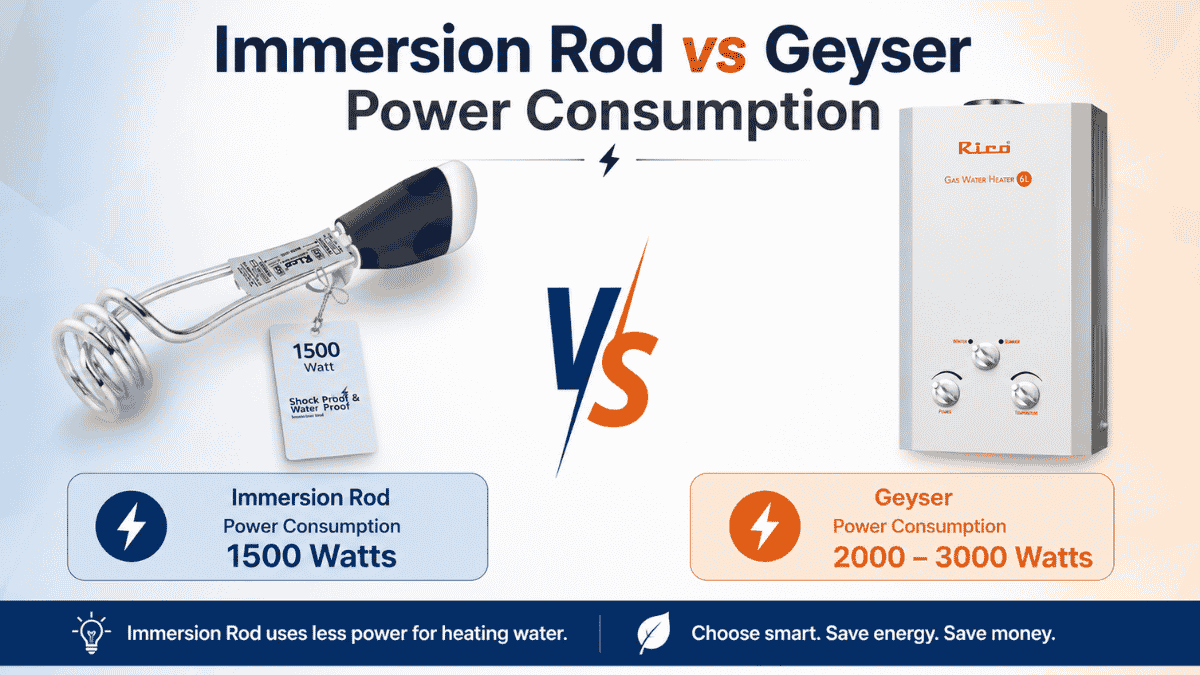
Immersion rod wattage: Typically ranges between 1000W and 1500W
-
Geyser wattage: Usually falls between 2000W and 3000W
-
Immersion rod heating time: Around 10 to 15 minutes for a bucket of water
-
Geyser heating time: Roughly 5 to 10 minutes for similar volumes
At first glance, geysers seem to draw more power. However, they heat water faster and retain warmth longer, thanks to the insulated tank. Immersion rods, in contrast, lose heat quickly and often need reheating, which increases their overall electricity consumption.
So, while comparing immersion rod vs geyser power consumption, it's important to look beyond wattage alone. Heating duration and insulation both matter equally.
If you're curious how wattage differences affect performance in other home appliances too, our breakdown of the difference between 550W and 750W mixer grinders explains a similar principle: higher wattage isn't always less efficient once you factor in speed and output.
Rico Immersion Rod Comparison
|
Model |
Wattage |
Price |
Colour |
Cord Length |
Warranty |
Key Feature |
|
Rico Immersion Rod IR2514 – 2000W, Shock Proof, ISI Certified |
2000W |
Rs. 1,500 |
Black |
1.6 m |
2-year replacement |
Fastest heating; copper element with nickel plating |
|
1500W |
Rs. 999 |
— |
1.6 m |
2-year replacement |
Built-in thermostat, auto temperature cut-off, water level indicator, bucket guard |
|
|
1500W |
Rs. 1,075 |
Purple |
1.6 m |
2-year replacement |
Lightweight at 460g; fully submersible design |
|
|
1000W |
Rs. 1,000 |
Purple |
1.6 m |
2 years |
Lightest at 422g; most budget-friendly option |
Why Geysers Often Win on Long-Term Efficiency
Geysers consume more power per minute. But they also heat water faster and hold that temperature for longer. This reduces the need for repeated heating cycles throughout the day. Immersion rods, meanwhile, cool down quickly once switched off. If your household needs hot water multiple times a day, you may end up reheating the bucket repeatedly. This repeated use can quietly push up your monthly electricity bill.
Ultimately, the immersion rod vs geyser power consumption debate isn't just about instant wattage. It's about how much total electricity each appliance uses across a full day of typical use.
Safety Considerations Matter Too
Power consumption isn't the only factor worth weighing. Safety plays an equally important role in this decision.
-
Immersion rods require manual handling and direct contact near water, which raises the risk of electric shock if used carelessly.
-
Geysers are wall-mounted and largely automated, reducing the chances of accidental contact.
-
Most modern geysers include thermostats and automatic safety cut-offs.
-
Immersion rods need constant supervision, especially around children.
Convenience, in most cases, favours geysers. However, immersion rods remain useful for smaller households, occasional use, or as a backup during power cuts or plumbing repairs.
Speaking of appliance choices during power fluctuations, many households also wonder if their other electrical devices work safely on backup power. If that's a concern for you too, our guide on using a mixer grinder on an inverter covers similar load and wattage considerations that apply to water heaters as well.
Cost Analysis: Beyond the Purchase Price
Immersion rods are undeniably cheaper to buy. Basic models start under Rs. 500, while a decent geyser can cost several thousand rupees.
However, the immersion rod vs geyser power consumption story doesn't end at the price tag. Geysers, despite their higher upfront cost, tend to be more economical over time due to better insulation and faster heating.
Frequent reheating with an immersion rod can quietly inflate your monthly electricity bill. So, if you use hot water daily, a geyser often pays for itself within a year or two through lower running costs.
This is similar to how choosing between two kitchen appliances often comes down to daily usage patterns rather than just sticker price. Our comparison of a wet grinder vs mixer grinder makes a similar point - the appliance with a higher upfront cost sometimes turns out cheaper to run in the long run.
Which One Should You Choose?
Your choice ultimately depends on household size, usage frequency, and budget. Here's a quick breakdown to help you decide.
Choose an immersion rod if:
-
You live alone or in a small household
-
You need hot water only occasionally
-
You want a low-cost, portable backup option
-
Your budget is tight right now
Choose a geyser if:
-
You have a larger family with daily hot water needs
-
You want consistent, automated convenience
-
You're willing to invest more upfront for long-term savings
-
Safety and ease of use are priorities
Interestingly, this decision mirrors other everyday appliance dilemmas at home. Just as some households debate manual effort versus electric convenience when picking kitchen tools, the same logic applies to water heating. Our article on manual vs electric vegetable choppers explores this exact trade-off between cost, effort, and convenience.
Tips to Reduce Power Consumption, Regardless of Your Choice
Whichever appliance you pick, a few simple habits can lower your electricity usage significantly.
-
Set your geyser's thermostat to a moderate temperature instead of the maximum setting.
-
Switch off the geyser once water reaches the desired temperature.
-
Avoid leaving an immersion rod running unattended, since this wastes both electricity and time.
-
Insulate exposed pipes to reduce heat loss between the heater and the tap.
-
Use a timer plug for immersion rods to prevent overheating.
Moreover, regular maintenance helps both appliances perform efficiently. A geyser with sediment buildup, for instance, takes longer to heat water and consumes more electricity as a result.
These efficiency principles apply across most home appliances, not just water heaters. If you're generally looking to make smarter appliance choices for your home, our detailed guide on how to choose the right mixer grinder offers a similar framework: match the appliance's power and features to your actual daily needs, not just the lowest price.
Environmental Impact
Energy efficiency isn't only about saving money. It also affects your household's carbon footprint.
Geysers, with their insulated tanks, generally waste less energy compared to immersion rods. Since immersion rods heat water without any insulation, they typically need more electricity to maintain the desired warmth.
If sustainability matters to you, a geyser with a high energy rating is usually the smarter long-term choice. Some models even support solar integration, which can reduce your environmental impact further while keeping electricity bills low.
Final Verdict on Immersion Rod vs Geyser Power Consumption
Both appliances have clear strengths. Immersion rods are cheap, portable, and useful for occasional or backup use. Geysers, meanwhile, offer better efficiency, safety, and convenience for regular, larger-scale hot water needs.
If you weigh the complete picture, immersion rod vs geyser power consumption comes down to usage frequency, not just wattage numbers. For daily use, a geyser is usually more economical. For occasional or single-person use, an immersion rod remains a practical, budget-friendly choice.
Before buying either appliance, consider your household size, usage habits, and long-term electricity costs together. That way, you'll make a decision that actually saves money, not just one that looks cheaper upfront.
Frequently Asked Questions
Q1. Which consumes more electricity: an immersion rod or a geyser?
Geysers draw more power per minute due to higher wattage. However, immersion rods often consume more electricity overall because they lose heat quickly and need frequent reheating.
Q2. Is an immersion rod cheaper to run than a geyser?
Not necessarily. While immersion rods have a lower purchase price, their lack of insulation can lead to higher electricity usage over time, especially with daily use.
Q3. How can I reduce geyser power consumption?
Set the thermostat to an optimal temperature, switch it off when not in use, insulate pipes, and schedule regular maintenance to prevent sediment buildup.
Q4. Are immersion rods safe to use daily?
Yes, if used correctly. Always ensure the rod is fully submerged before switching it on, and never touch the water while it's operating.
Q5. Which is better for a large family: immersion rod or geyser?
A geyser is generally better for large families, since it provides continuous hot water automatically. Immersion rods work best for smaller households or occasional use.