
Difference Between Nutri Blender and Mixer Grinder: Which One Fits Your Kitchen?
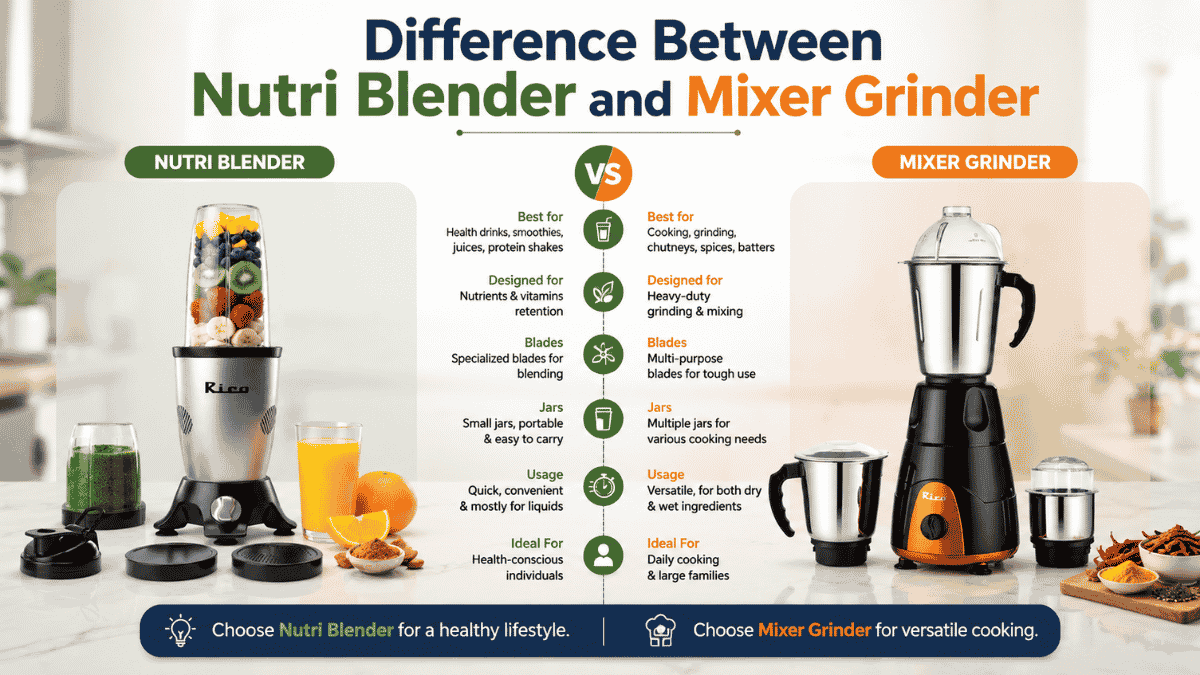
Modern kitchens are full of shiny new gadgets, and the Nutri blender is one of the most talked-about additions. But many people still can't pinpoint the exact difference between a Nutri blender and a mixer grinder, since both machines blend, grind, and crush ingredients.
However, these two appliances serve different purposes. One is built for speed and smoothies, while the other is designed for everyday Indian cooking, from chutneys and masalas to dry spice powders.
If you're looking for dependable kitchen appliances, Rico offers a wide range of mixer grinders, juicers, blenders, steam irons, fans, and other home appliances. Known for their durable build, powerful motors, and user-friendly designs, Rico products simplify daily household tasks while delivering reliable performance.
This guide breaks down the differences between a Nutri blender and a mixer grinder in terms of power, jars, versatility, and price. By the end, you'll know exactly which one belongs on your countertop.
What Is a Nutri Blender?
A Nutri blender is a compact appliance built primarily for smoothies, shakes, and juices. It uses a single extractor jar with sharp blades that spin at very high speed, often above 20,000 RPM.
This high-speed action breaks down fruits, seeds, and leafy greens into a smooth, drinkable consistency. Therefore, it's a favourite among fitness enthusiasts and anyone who values quick, no-fuss morning routines.
However, Nutri blenders aren't built for heavy-duty tasks. They typically lack the power and jar variety needed for grinding spices or making thick batters.
What Is a Mixer Grinder?
A mixer grinder is a multi-purpose kitchen appliance designed to handle a wider range of tasks. It usually comes with two or three jars, each suited to a specific job, like wet grinding, dry grinding, and chutney-making.
Its motor is generally more powerful than a Nutri blender's, allowing it to grind hard spices, knead thick batters, and crush ice with ease. Consequently, it remains a staple in most Indian kitchens.
Some mixer grinders also include juicer attachments, adding further versatility. This makes the appliance a genuine all-rounder for daily cooking needs.
Difference Between Nutri Blender and Mixer Grinder: Key Factors
Let's compare both appliances across the factors that actually matter for everyday use.
1. Motor Power and Speed
Mixer grinders generally have stronger motors, built to handle heavy grinding tasks like turmeric, dals, and thick batters. Nutri blenders, meanwhile, focus on high RPM rather than raw power, since their job is blending rather than grinding.
This is a principle similar to how motor power affects performance in mixer grinders. Our detailed look at the difference between 550W and 750W mixer grinders explains how wattage translates into actual grinding capability.
2. Jars and Attachments
A mixer grinder typically comes with multiple jars for wet grinding, dry grinding, and chutney-making. A Nutri blender, in contrast, usually has just one or two jars, both meant for blending.
Some mixer grinders also include a whisking attachment for eggs or cream, expanding their use beyond grinding. If you're curious about that feature, our guide on what a whip in a mixer grinder does explains how it works and when to use it.
3. Versatility in the Kitchen
Mixer grinders are true multitaskers. They handle spice grinding, batter preparation, chutneys, and sometimes even juicing, depending on the attachments included.
Nutri blenders, however, are specialists. They excel at smoothies and shakes but struggle with traditional Indian cooking tasks like grinding masalas or preparing idli batter.
If you already own a mixer grinder and want to explore its full range of uses, our article on how to use a juicer mixer grinder walks through the different jars and their specific functions.
4. Noise Levels
Both appliances can be loud, but for different reasons. Nutri blenders produce a sharp, high-pitched whine due to their high-speed motors. Mixer grinders, meanwhile, generate a lower-pitched hum that many find more familiar.
If noise is a concern in your household, especially during early mornings, our guide on how to reduce the noise of a mixer grinder offers practical fixes that apply to most motor-driven kitchen appliances.
5. Cleaning and Convenience
Nutri blenders are easier to clean, thanks to their compact jar-blade design. A quick rinse is usually enough. Mixer grinders, with multiple jars and detachable blades, need a bit more effort and time at the sink.
For those focused on quick, fuss-free mornings, this convenience factor often tips the scales toward a Nutri blender, at least for daily smoothies.
6. Nutrition and Texture
Nutri blenders claim to preserve more nutrients through faster blending and finer extraction. In reality, most nutrients survive regular blending too, especially when you don't discard the fibrous parts of fruits and vegetables.
That said, Nutri blenders do deliver a smoother, café-style texture. This matters if you're blending fibrous greens like spinach or kale for a drinkable consistency.
7. Price and Value
Nutri blenders are usually more affordable than full-sized mixer grinders, considering their narrower focus. However, if you already own a mixer grinder, adding a Nutri blender only makes sense if smoothies and shakes are a regular part of your routine.
For traditional cooking needs like grinding pastes and masalas, a mixer grinder still offers better overall value.
Nutri Blender vs Mixer Grinder: Quick Comparison Table
|
Feature |
Nutri Blender |
Mixer Grinder |
|
Best for |
Smoothies, shakes, juices |
Chutneys, batters, spices |
|
Motor speed |
Very high RPM |
Moderate to high power |
|
Jars |
1–2 jars |
2–3 jars, task-specific |
|
Versatility |
Limited to blending |
Wide range of tasks |
|
Cleaning |
Quick and easy |
Requires more effort |
|
Price |
Generally lower |
Moderate to higher |
Should You Buy a Nutri Blender or a Mixer Grinder?
Your decision ultimately depends on your daily cooking habits. Here's a simple way to think about it.
Choose a Nutri blender if:
-
You want quick smoothies, shakes, or protein drinks
-
You prioritise convenience over versatility
-
You're short on kitchen counter space
-
Your cooking rarely involves grinding spices or batters
Choose a mixer grinder if:
-
You cook traditional Indian meals regularly
-
You need to grind spices, dals, or thick batters
-
You want one appliance that handles multiple tasks
-
You value long-term durability and easy part replacement
Interestingly, this decision resembles other kitchen appliance trade-offs. Just as some households weigh wet grinding needs against everyday mixer-grinder use, the same logic applies here. Our comparison of a wet grinder vs mixer grinder explores a similar decision between specialisation and versatility.
What About Juicing Needs?
If your main goal is fresh juice rather than smoothies, neither appliance may be the perfect fit. Juicers separate pulp from liquid, while both Nutri blenders and mixer grinders blend everything, fibre included. If juicing is a priority, it helps to understand your options further. Our guide on centrifugal vs slow juicers breaks down how dedicated juicers differ from blending appliances, and which one suits your health goals better.
Similarly, if you're deciding between a blender and a slow juicer for daily use, our comparison of a slow juicer vs blender covers nutrient retention and convenience in more depth.
Power Considerations During Outages
If power cuts are common in your area, it's worth checking whether your kitchen appliances can run on backup power. Mixer grinders, in particular, draw a fair amount of current during startup.
Our article on using a mixer grinder on an inverter explains the load requirements involved, which is useful information whether you're using a mixer grinder or considering a Nutri blender as a lighter alternative.
Final Thoughts
The difference between Nutri blender and mixer grinder ultimately comes down to purpose. A Nutri blender suits quick, health-focused blending, while a mixer grinder remains the more versatile choice for everyday Indian cooking.
Many households find value in owning both, using each appliance for what it does best. If you're still unsure which one fits your kitchen, our detailed guide on how to choose the right mixer grinder can help you evaluate power, jars, and features before you buy.
Ultimately, the right choice depends on your cooking style, not just the appliance's marketing claims. Consider your daily needs first, and the decision becomes much easier.
Frequently Asked Questions
Q1. What is the main difference between a Nutri blender and a mixer grinder?
A Nutri blender is designed mainly for smoothies and shakes, using a single high-speed jar. A mixer grinder is more versatile, with multiple jars for grinding spices, batters, and chutneys.
Q2. Can a Nutri blender replace a mixer grinder?
Not entirely. While a Nutri blender handles blending tasks well, it lacks the power and jar variety needed for traditional Indian cooking, like grinding masalas or kneading thick batters.
Q3. Does a Nutri blender preserve more nutrients than a mixer grinder?
Not significantly. Most nutrients remain intact with regular blending too, especially if you include fibrous parts of fruits and vegetables. The main difference lies in texture, not nutrition.
Q4. Which is more affordable: a Nutri blender or a mixer grinder?
Nutri blenders are generally cheaper due to their narrower functionality. Mixer grinders cost more but offer a wider range of uses, making them better value for regular cooking.
Q5. Is a mixer grinder harder to clean than a Nutri blender?
Yes, typically. Mixer grinders have multiple jars and detachable blades, which take more time to clean compared to a Nutri blender's simple, single-jar design.