
Rechargeable Fan vs Air Cooler: Which One Cools Your Home Better?
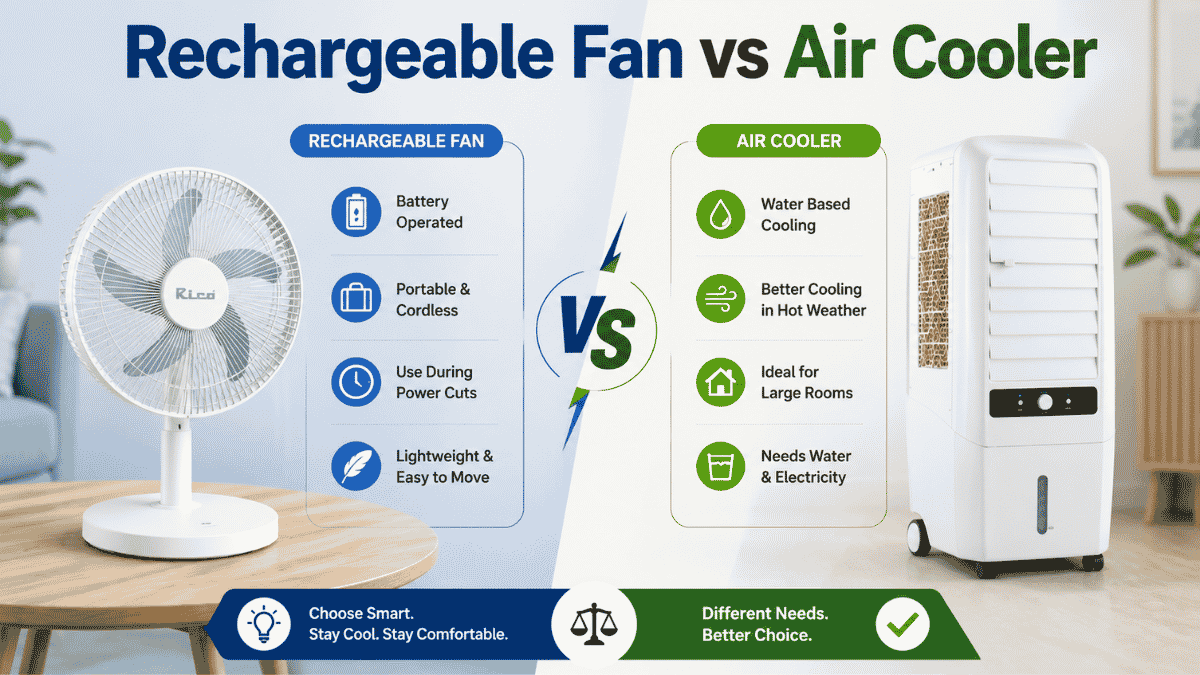
Summer shopping often comes down to one decision: rechargeable fan vs air cooler. Both promise relief from the heat, but they work in completely different ways and suit different needs.
A rechargeable fan simply moves air around using a battery-powered motor, while an air cooler actively lowers air temperature through water evaporation. This difference affects everything from cooling performance and portability to electricity consumption and overall operating costs.
If you're looking for reliable cooling appliances, Rico offers a wide range of home appliances, including rechargeable fans, air coolers, pedestal fans, mixer grinders, steam irons, and other everyday essentials. Rico products are designed to combine energy efficiency, dependable performance, and durable quality, making them well-suited for Indian homes and varying seasonal needs.
This guide compares a rechargeable fan vs air cooler across performance, power consumption, portability, and cost, helping you choose the option that best fits your space, budget, and cooling requirements.
How Does Each Appliance Work?
A rechargeable fan uses a battery-powered motor to circulate air, creating a wind-chill effect that cools your skin without actually lowering room temperature. It's essentially a portable version of a regular fan, built for convenience and power-cut backup.
An air cooler works differently. It draws warm air through water-soaked cooling pads, and as the water evaporates, it absorbs heat and releases noticeably cooler air into the room. This process can lower room temperature by several degrees, especially in dry climates.
Understanding this fundamental difference is the first step in the rechargeable fan vs air cooler decision, since it shapes everything else in this comparison.
Rechargeable Fan vs Air Cooler: Power Consumption
Power consumption is often the deciding factor for many households. Here's how the two compare.
-
Rechargeable fans: Consume minimal electricity, mainly during charging. Once running on battery, they draw no power from the mains at all.
-
Air coolers: Typically consume between 100 and 200 watts per hour, depending on size and fan speed.
-
Regular electric fans, for comparison: Usually consume around 45 to 75 watts per hour.
So, in the rechargeable fan vs air cooler comparison, fans clearly use far less electricity. However, air coolers justify their higher consumption by delivering genuine temperature reduction, not just airflow.
If you're evaluating appliance wattage more broadly, our guide on the difference between 550W and 750W mixer grinders explains a similar principle: higher wattage often means stronger performance, but it comes with a trade-off in running cost.
Cooling Performance: Which One Feels Cooler?
This is where air coolers pull ahead significantly. Since they work through evaporative cooling, they can lower room temperature by 5 to 10°C in dry conditions, offering genuine relief during peak summer.
Rechargeable fans, meanwhile, only circulate existing air. They don't reduce the actual temperature, so their cooling effect is more limited, especially in already hot, humid environments.
Therefore, if raw cooling performance is your priority, an air cooler will outperform a rechargeable fan in most conditions, particularly in dry regions where evaporative cooling works best.
Portability and Convenience
Rechargeable fans win decisively here. Their compact, battery-powered design makes them easy to carry between rooms, desks, or even outdoors during travel.
Air coolers, while sometimes fitted with wheels for mobility, are considerably bulkier and heavier due to their water tank and cooling pad assembly. Moving them frequently is far less convenient.
If portability matters most to you, exploring dedicated options like a portable fan can help you find a lightweight solution built specifically for on-the-go cooling.
This kind of trade-off between portability and performance shows up across other appliances too. Our comparison of heavyweight vs lightweight iron boxes explores a similar decision between convenience and stronger output.
Power Cuts and Backup Reliability
This is one of the strongest advantages of a rechargeable fan. Since it runs on an internal battery, it continues working seamlessly during power cuts, a common challenge in many Indian households.
Air coolers, in contrast, depend entirely on a live electricity connection. Once the power goes out, they stop functioning immediately, unless connected to an inverter or generator with sufficient capacity.
If backup power is a regular concern in your home, it helps to understand how other appliances handle limited power too. Our article on using a mixer grinder on an inverter covers similar load considerations relevant to running cooling appliances on backup power.
Noise Levels
Rechargeable fans generally operate quietly, especially at lower speed settings, making them suitable for bedrooms and study areas. Air coolers, particularly larger models running at high speed, tend to produce more noise due to their internal motor and water circulation system.
If noise matters for your daily routine, our guide on how to reduce the noise of a mixer grinder shares practical maintenance tips that apply broadly to most motor-driven home appliances, including cooling devices.
Maintenance Requirements
Rechargeable fans require minimal upkeep. Occasional cleaning of the blades and grill is usually enough to keep them running smoothly.
Air coolers, however, need more regular maintenance. Cooling pads should be cleaned periodically to prevent mould and mineral buildup, and the water tank needs frequent refilling and cleaning to avoid stagnant water issues.
This added maintenance is worth factoring into your decision, especially if you prefer a low-effort cooling solution.
Climate Suitability
Air coolers perform best in dry, low-humidity climates, where evaporative cooling is most effective. In humid regions, their cooling effect diminishes significantly, since the air is already saturated with moisture.
Rechargeable fans, since they simply move air rather than alter its humidity, perform consistently regardless of climate. This makes them a more universally reliable choice, even if their cooling power is comparatively modest.
Rechargeable Fan vs Air Cooler: Quick Comparison Table
|
Feature |
Rechargeable Fan |
Air Cooler |
|
Cooling method |
Air circulation |
Evaporative cooling |
|
Power consumption |
Minimal, battery-based |
100–200W per hour |
|
Works during power cuts |
Yes |
No, unless on backup power |
|
Portability |
Highly portable |
Bulkier, less convenient |
|
Best climate |
Any climate |
Dry, low-humidity regions |
|
Maintenance |
Low |
Moderate to high |
|
Noise level |
Generally quiet |
Can be louder at high speed |
Which One Should You Choose?
Your decision in the rechargeable fan vs air cooler debate depends on your priorities. Here's a simple breakdown to help.
Choose a rechargeable fan if:
-
You experience frequent power cuts and need reliable backup cooling
-
Portability and low maintenance matter more than strong cooling
-
You live in a humid climate where evaporative cooling is less effective
-
You want a quiet, energy-efficient option for personal use
Choose an air cooler if:
-
You live in a dry or moderately hot climate
-
You need noticeable temperature reduction, not just airflow
-
You're cooling a larger room and have a consistent power supply
-
You don't mind occasional maintenance for stronger performance
Can You Use Both Together?
Many households find value in owning both. An air cooler can handle daily cooling for larger rooms, while a rechargeable fan serves as a reliable backup during outages or for quick, personal cooling.
This kind of layered approach mirrors how people often build out their broader appliance setup at home. If you're planning your household appliances more holistically, our roundup of kitchen products covers other everyday essentials worth considering alongside your cooling setup.
Tips to Maximise Efficiency, Whichever You Choose
A few simple habits can improve performance and reduce running costs for either appliance.
-
Clean fan blades and cooler pads regularly to maintain efficient airflow.
-
Use lower speed settings when full power isn't necessary.
-
Position your appliance away from walls or furniture for better air circulation.
-
For air coolers, refill the water tank with cool water for improved cooling effect.
-
For rechargeable fans, avoid letting the battery fully drain repeatedly, as this can shorten its lifespan.
Final Verdict
The rechargeable fan vs air cooler decision ultimately comes down to your climate, power reliability, and cooling priorities. Rechargeable fans offer portability and dependable backup during outages, while air coolers deliver genuinely lower temperatures, particularly in dry regions.
If your main concern is power cuts and convenience, a rechargeable fan makes more sense. However, if strong, noticeable cooling matters most and your climate supports evaporative cooling, an air cooler is the better long-term choice.
Ultimately, understanding how each appliance works and matching it to your specific climate and needs makes the rechargeable fan vs air cooler choice much easier.
Frequently Asked Questions
Q1. Which consumes less electricity: a rechargeable fan or an air cooler?
A rechargeable fan consumes far less electricity, since it draws power only during charging. Air coolers typically use 100 to 200 watts per hour during operation.
Q2. Does a rechargeable fan cool a room as effectively as an air cooler?
No, not usually. A rechargeable fan only circulates air, while an air cooler can genuinely lower room temperature by several degrees through evaporative cooling.
Q3. Can an air cooler work during a power cut?
No, not unless it's connected to an inverter or another backup power source, since it depends entirely on mains electricity.
Q4. Is an air cooler suitable for humid climates?
Not ideally. Air coolers work best in dry, low-humidity conditions. In humid regions, their cooling effect is significantly reduced.
Q5. Which requires more maintenance: a rechargeable fan or an air cooler?
Air coolers generally require more maintenance, including regular cleaning of cooling pads and the water tank, compared to the minimal upkeep needed for a rechargeable fan.