
Centrifugal Juicer Benefits: Why This Juicer Type Remains a Popular Choice
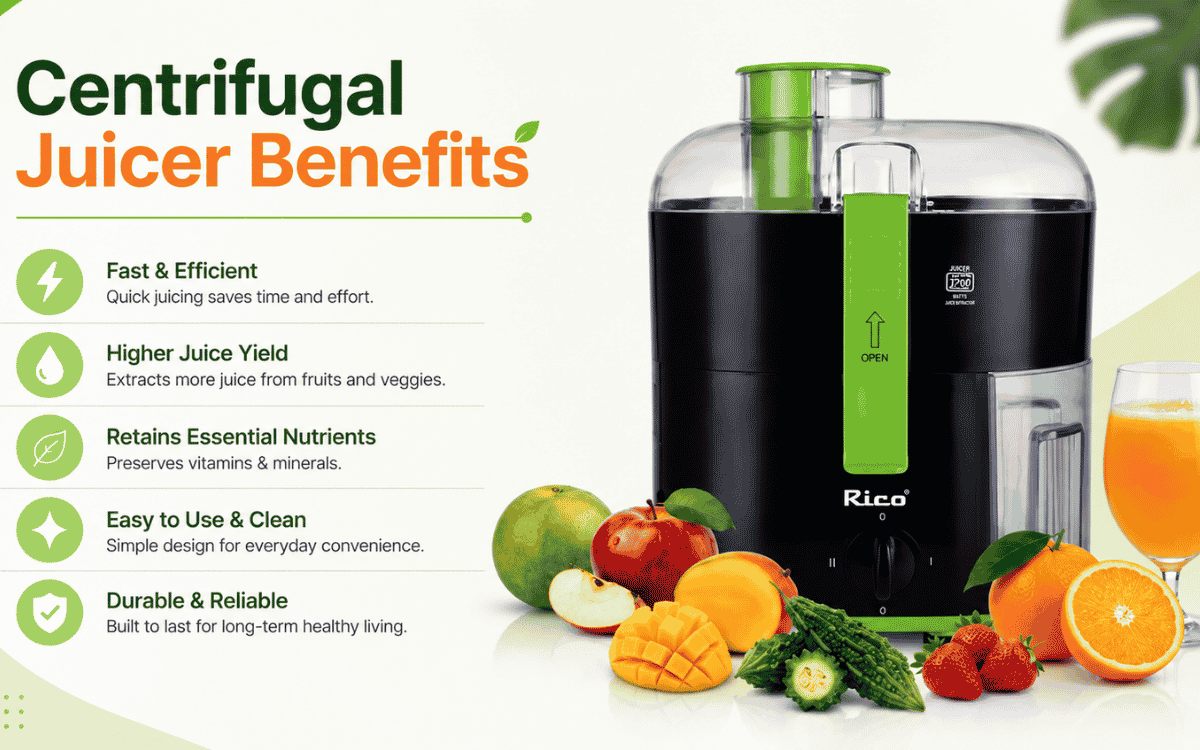
If you're new to juicing, understanding centrifugal juicer benefits is a great place to start. These machines are widely available, budget-friendly, and remarkably fast, making them the most common entry point into home juicing.
While slower juicing methods get plenty of attention for nutrient retention, the centrifugal juicer benefits that matter most to everyday users are speed, convenience, and ease of use.
This guide breaks down the full range of centrifugal juicer benefits, along with a few honest trade-offs, so you can decide if this juicing method fits your lifestyle. Looking for a reliable model to start with? Rico's range of juicers is built for exactly this kind of everyday convenience.
What Makes a Centrifugal Juicer Different?
A centrifugal juicer uses a fast-spinning blade and mesh basket to shred produce and separate juice from pulp within seconds. This high-speed mechanism is the foundation of nearly every centrifugal juicer benefit discussed in this guide.
Unlike slower masticating or cold press machines, centrifugal juicers prioritise speed over gentle extraction. Understanding this trade-off helps set realistic expectations before you buy.
Top Centrifugal Juicer Benefits
1. Speed and Efficiency
This is arguably the most significant centrifugal juicer benefit. The spinning blade cuts and extracts juice almost instantly, letting you go from whole produce to a finished glass of juice in under a minute.
For busy mornings or households juicing for multiple people, this speed advantage is hard to match. Moreover, most models accept whole or roughly chopped fruits and vegetables, which further reduces prep time.
2. Affordability
Centrifugal juicers are generally more affordable than masticating or cold press alternatives. Their simpler mechanical design keeps manufacturing costs lower, which translates into a friendlier price tag for consumers.
This affordability is one of the key centrifugal juicer benefits that makes juicing accessible to first-time buyers who aren't ready to invest in premium equipment.
3. Easy Cleanup and Maintenance
Centrifugal juicers typically feature fewer parts than slower alternatives, with straightforward, often dishwasher-safe components. Rinsing the basket and wiping down the blade usually takes just a few minutes.
This convenience matters, especially for regular users, since juicers that are difficult to clean often get used less over time. Compared to appliances with multiple jars and attachments, our guide on how to use a juicer mixer grinder shows how cleaning routines vary across different appliance types.
4. Minimal Prep Time
Since centrifugal juicers can handle whole or lightly chopped produce, you spend far less time prepping ingredients compared to slower juicing methods that often require smaller pieces for optimal extraction.
Therefore, if convenience is your priority, this is one of the more practical centrifugal juicer benefits for daily use.
5. Wide Availability and Compact Design
Centrifugal juicers are among the most common juicer types on the market, making them easy to find across a wide range of brands and price points. Most models also have a compact, countertop-friendly design.
This accessibility means you don't need to search extensively or compromise on kitchen space to enjoy the centrifugal juicer benefits of home juicing.
6. Versatility with Different Produce
Centrifugal juicers handle a wide variety of fruits and vegetables effectively, particularly harder produce like apples, carrots, and beets. Their powerful blades make quick work of dense ingredients that slower juicers may take longer to process.
If you're curious how this compares to wet grinding mechanisms used in other kitchen appliances, our comparison of wet grinder vs mixer grinder explores how different blade and motor designs affect processing speed and texture.
7. Beginner-Friendly Operation
Centrifugal juicers are generally simple to operate, with straightforward controls and minimal learning curve. This makes them an approachable choice for anyone just starting their juicing journey.
Honest Trade-Offs to Consider
While the centrifugal juicer benefits are compelling, it's worth understanding the trade-offs too, for a balanced decision.
-
Some nutrient loss: The heat and oxidation generated during high-speed spinning can cause minor nutrient degradation compared to slower methods.
-
Shorter juice freshness: Centrifugal juice tends to separate and lose freshness faster, so it's best consumed immediately.
-
Lower yield from leafy greens: Centrifugal juicers typically extract less juice from leafy greens like spinach or kale compared to masticating machines.
-
Noise levels: The high-speed motor tends to be louder than slower juicing alternatives.
Weighing these trade-offs against the centrifugal juicer benefits helps you decide whether speed and convenience outweigh maximum nutrient extraction for your specific needs.
Centrifugal Juicer vs Other Juicing Methods
Understanding how centrifugal juicers compare to alternatives puts their benefits into clearer context.
-
Masticating (slow) juicers: Operate at low speed, preserving more nutrients but taking longer to produce juice.
-
Cold press juicers: Use hydraulic pressure instead of spinning blades, resulting in the highest juice quality but at a higher price and slower process.
-
Blenders: Blend everything, including fibre, rather than separating juice from pulp.
If you're weighing speed against nutrient retention, our detailed comparison of centrifugal vs slow juicers breaks down exactly how these two juicer types differ in performance and output quality.
For a closer look specifically at extraction efficiency and juice yield, our article on centrifugal juicer vs slow juicer covers additional factors worth considering before you buy.
Who Benefits Most from a Centrifugal Juicer?
The centrifugal juicer benefits discussed above make this appliance particularly well-suited for certain lifestyles. Consider a centrifugal juicer if:
-
You want fresh juice quickly, without lengthy prep or waiting time
-
You're new to juicing and want an affordable, low-commitment entry point
-
You typically drink juice immediately rather than storing it for later
-
You juice mostly harder produce like apples, carrots, or beets
-
Easy cleanup matters more to you than maximum nutrient retention
On the other hand, if you frequently juice leafy greens or want to batch-prepare juice for the week ahead, a slower method might better suit your needs. Our comparison of slow juicer vs blender explores how different appliances handle fibrous ingredients and thicker blends.
Comparing Centrifugal Juicers to Cold Press Options
If nutrient preservation becomes more important to you over time, it helps to understand the alternative. Cold press juicers use hydraulic pressure rather than spinning blades, resulting in juice with a longer shelf life and higher nutrient content.
Our guide on how a cold press juicer works walks through this mechanism in detail, offering useful contrast to the speed-focused centrifugal juicer benefits covered here.
If you eventually decide cold press suits your needs better, our roundup on which cold press juicer is best can help you compare specific models and features.
Tips to Maximise Centrifugal Juicer Benefits
A few simple habits help you get the most out of your machine.
-
Alternate hard and soft produce to prevent clogging and maintain consistent extraction.
-
Drink juice immediately after preparation to enjoy maximum freshness.
-
Clean the basket and blade right after use to prevent pulp from drying and sticking.
-
Cut larger produce into manageable pieces, even if the machine accepts whole fruit, to reduce strain on the motor.
-
Avoid overloading the feed tube, since this can slow extraction and reduce juice quality.
Following these habits ensures you experience the full range of centrifugal juicer benefits consistently, rather than dealing with clogs or uneven results.
Building a Well-Rounded Kitchen Setup
A centrifugal juicer works well alongside other everyday kitchen appliances. If you're building out your broader kitchen essentials, our roundup of kitchen products covers additional appliances worth considering for a fully equipped, efficient kitchen.
Final Thoughts
The centrifugal juicer benefits of speed, affordability, and easy cleanup make this appliance a practical choice for most households, especially those juicing occasionally or on busy mornings.
While slower juicing methods offer certain nutritional advantages, the convenience and accessibility of a centrifugal juicer remain hard to beat for everyday use. Ultimately, choosing the right juicer comes down to matching these centrifugal juicer benefits against your specific juicing habits and priorities.
Frequently Asked Questions
Q1. What are the main benefits of a centrifugal juicer?
The primary centrifugal juicer benefits include speed, affordability, easy cleanup, and minimal prep time, making it a convenient choice for everyday juicing.
Q2. Are centrifugal juicers good for beginners?
Yes, they're widely considered beginner-friendly due to their simple controls, straightforward operation, and lower price point compared to other juicer types.
Q3. Do centrifugal juicers lose nutrients during juicing?
Some minor nutrient loss can occur due to heat and oxidation during high-speed spinning. However, the juice still retains a substantial amount of vitamins and minerals.
Q4. Can a centrifugal juicer handle leafy greens well?
Not as effectively as slower juicers. Centrifugal juicers typically yield less juice from leafy greens like spinach or kale compared to masticating or cold press machines.
Q5. Is a centrifugal juicer worth buying for occasional use?
Yes, its affordability, speed, and easy cleanup make it a practical choice for occasional or beginner-level juicing, without a significant upfront investment.