
How Does a Centrifugal Juicer Work? A Complete Breakdown
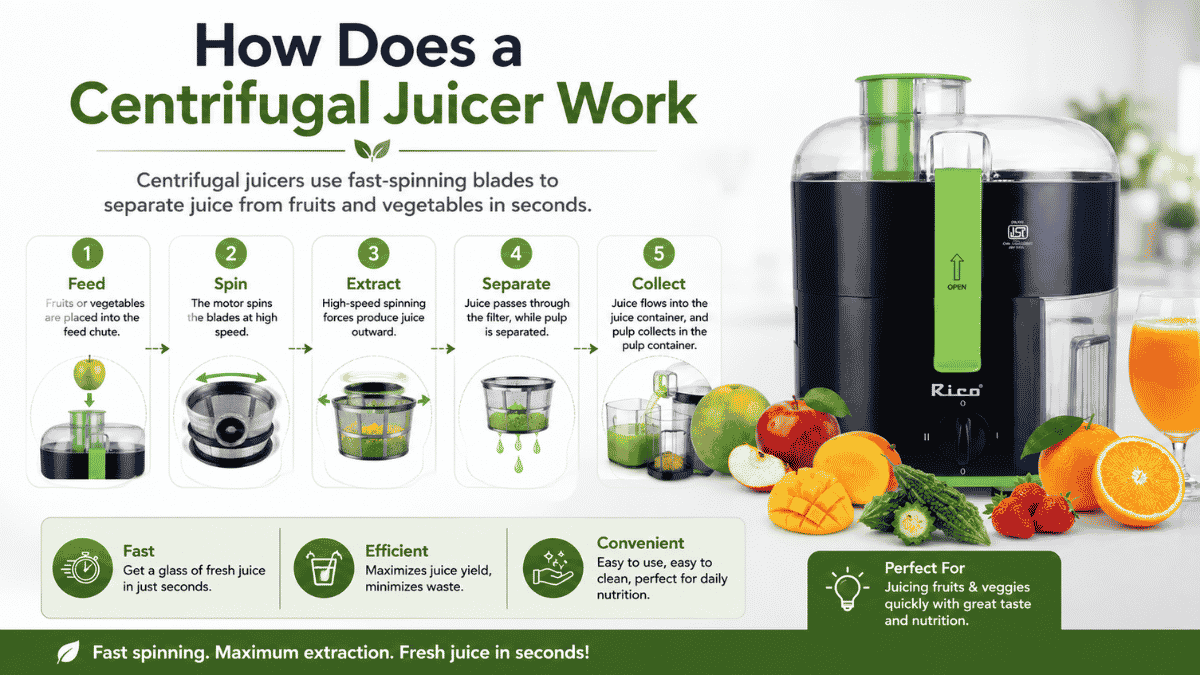
If you've ever wondered how a centrifugal juicer works, the short answer is simple: speed and force. These machines use a fast-spinning blade and mesh basket to shred fruits and vegetables, separating the juice from the pulp in just a few seconds.
Centrifugal juicers are the most common type found in homes today. They're affordable, quick, and easy to use, making them a popular choice for anyone new to juicing.
For those looking for reliable kitchen appliances, Rico offers a range of high-quality home and kitchen products, including juicers, mixer grinders, blenders, steam irons, fans, and other everyday appliances. Rico is known for combining durable construction, efficient performance, and user-friendly designs to make daily cooking and food preparation easier.
In this guide, we'll explain exactly how a centrifugal juicer works, what happens inside the machine, and how it compares to other juicing methods available today.
What Is a Centrifugal Juicer?
A centrifugal juicer is a juicing appliance that uses a rapidly spinning metal blade and mesh basket to extract juice from fruits and vegetables. The name comes from centrifugal force, the same force that pushes you outward on a spinning merry-go-round.
This appliance is popular because it's fast, budget-friendly, and simple to operate. You feed produce through a chute, and within seconds, you get a glass of fresh juice.
Understanding how a centrifugal juicer works helps you decide whether it fits your juicing habits, especially if speed and convenience matter more than maximum nutrient extraction.
How Does a Centrifugal Juicer Work? Step-by-Step
Let's break down the actual mechanism inside the machine.
1. Feeding the produce: Fruits or vegetables are pushed through a feed tube toward a spinning blade at the base of the machine.
2. Shredding: The blade, spinning at speeds between 6,000 and 14,000 RPM, cuts and shreds the produce almost instantly.
3. Spinning basket: The shredded pulp sits inside a perforated basket that spins at high speed.
4. Centrifugal separation: This spinning motion throws the juice outward through the mesh, while the solid pulp stays behind in the basket.
5. Juice collection: The extracted juice flows into a spout or jug, ready to drink immediately.
This entire process happens in seconds, which is exactly why centrifugal juicers are also known as fast juicers. However, this speed comes with trade-offs worth understanding.
If you're comparing juicing appliances to grinding appliances more broadly, our guide on how to use a juicer mixer grinder explains how similar spinning-blade mechanisms work across different kitchen tools.
Why Speed Comes With Trade-Offs
Since centrifugal juicers operate at very high RPM, they generate noticeable heat and friction during juicing. This process can introduce oxygen into the juice, a phenomenon known as oxidation.
Oxidation doesn't make the juice unsafe. However, it does shorten shelf life and can cause the juice to separate quickly. Consequently, centrifugal juice is best consumed immediately rather than stored for later.
Additionally, since the blade chops produce so quickly, the resulting juice may contain a higher percentage of solid matter, like small bits of skin, seeds, or fibre, compared to slower juicing methods.
Centrifugal Juicer vs Other Juicing Methods
Now that you understand how a centrifugal juicer works, it helps to see how it stacks up against alternatives.
-
Masticating (slow) juicers: These crush produce at a much slower 80–100 RPM, generating less heat and preserving more nutrients.
-
Twin gear juicers: These use two gears to chew produce thoroughly, offering excellent extraction but at a higher price and slower speed.
-
Cold press juicers: These first chop produce, then apply hydraulic pressure to extract juice without heat, resulting in the highest juice quality.
If you're deciding between speed and nutrient retention, our detailed comparison of centrifugal vs slow juicers breaks down exactly how these two popular types differ in performance and output.
For a closer look at extraction efficiency specifically, our article on centrifugal juicer vs slow juicer covers juice yield, pulp content, and which one suits daily use better.
Benefits of a Centrifugal Juicer
Despite the trade-offs, centrifugal juicers remain popular for good reason. Here's why so many households choose them.
-
Speed: You get juice in seconds, ideal for busy mornings.
-
Affordability: Centrifugal models are generally cheaper than masticating or cold press juicers.
-
Minimal prep: Most models accept whole or roughly chopped produce, saving prep time.
-
Easy cleaning: Fewer parts and straightforward basket design make cleanup quick.
-
Beginner-friendly: Simple controls make these juicers approachable for first-time users.
These strengths make centrifugal juicers a practical entry point, especially if you're juicing occasionally rather than committing to daily large batches.
Limitations Worth Knowing
Along with the benefits, it's worth understanding what centrifugal juicers don't do as well.
-
Juice tends to separate and lose freshness faster due to oxidation.
-
The juicing process is noisier compared to slower alternatives.
-
Leafy greens like spinach or kale yield less juice than they would in slower machines.
-
Frequent use can wear down blades faster, given the high rotational speed.
If you often juice leafy greens or want to batch-prepare juice for the week, a slower method might serve you better. Our comparison of a slow juicer vs blender explains how different appliances handle fibrous ingredients and thicker blends.
How Centrifugal Juicers Compare to Cold Press Juicers
Cold press juicers work on a completely different principle. Instead of spinning blades, they first chop produce into a coarse pulp, then apply intense hydraulic pressure to extract juice without generating heat. This method preserves more vitamins and enzymes, and the resulting juice lasts significantly longer in the fridge. However, cold press machines are considerably more expensive and slower to operate.
If you're curious about this method in more detail, our guide on how a cold press juicer works walks through the mechanics step by step, which pairs well with understanding how a centrifugal juicer works by contrast.
And if you've already decided cold press is the direction you want to go, our roundup on which cold press juicer is best can help narrow down your options.
Who Should Choose a Centrifugal Juicer?
A centrifugal juicer suits certain lifestyles better than others. Consider this appliance if:
-
You want fresh juice quickly, without lengthy prep or cleanup
-
You're new to juicing and want an affordable entry point
-
You typically drink juice immediately rather than storing it
-
Your budget is a primary concern
On the other hand, if nutrient retention, shelf life, or juicing leafy greens matters more to you, a slower juicing method may be worth the extra investment.
Tips to Get the Most Out of Your Centrifugal Juicer
A few simple habits can improve your results and extend the appliance's lifespan.
-
Cut produce into smaller pieces before feeding it in, even though most models accept whole fruit, to reduce strain on the motor.
-
Alternate hard and soft produce to keep the blade from clogging.
-
Drink the juice immediately for maximum freshness and nutrient content.
-
Clean the basket and blade right after use to prevent pulp from drying and sticking.
-
Avoid overloading the feed tube, since this can slow down extraction and affect juice quality.
Following these habits ensures consistent results every time you use the machine.
Centrifugal Juicers and Everyday Kitchen Appliances
Interestingly, the spinning-blade mechanism used in centrifugal juicers shares similarities with other kitchen appliances that rely on high-speed rotation. If you're building out your kitchen with multiple appliances, our broader guide on kitchen products covers a range of essentials worth considering alongside your juicer.
Similarly, if you're comparing grinding appliances that use a comparable wet-processing approach, our article on wet grinder vs mixer grinder explores how different motor and blade designs affect texture and output, a useful parallel to understanding juicer mechanics.
Final Thoughts
So, how does a centrifugal juicer work? In short, it shreds produce with a fast-spinning blade, then uses centrifugal force to separate juice from pulp within seconds. This makes it one of the quickest and most convenient juicing methods available.
However, that speed does come with some trade-offs, including faster oxidation and slightly lower nutrient retention compared to slower juicing methods. For most casual juicers, these trade-offs are a fair exchange for convenience and affordability.
Ultimately, understanding how a centrifugal juicer works helps you set realistic expectations and get the best results from your machine, whether you're juicing daily or just occasionally.
Frequently Asked Questions
Q1. How does a centrifugal juicer work compared to a blender?
A centrifugal juicer separates juice from pulp using spinning blades and centrifugal force. A blender, in contrast, blends everything, including fibre, resulting in a thicker consistency rather than clear juice.
Q2. Does a centrifugal juicer destroy nutrients?
Centrifugal juicers generate some heat and oxidation during juicing, which can cause minor nutrient loss. However, the juice still retains a significant amount of vitamins and minerals.
Q3. Is a centrifugal juicer good for leafy greens?
Not ideally. Centrifugal juicers tend to yield less juice from leafy greens like spinach or kale compared to slower masticating or cold press juicers.
Q4. How long does centrifugal juicer juice last?
Due to oxidation, centrifugal juice is best consumed immediately. It typically doesn't stay fresh for more than a few hours, even when refrigerated.
Q5. Are centrifugal juicers easy to clean?
Yes, generally. Most centrifugal juicers have fewer parts than masticating or twin gear models, making cleanup quicker and more convenient.